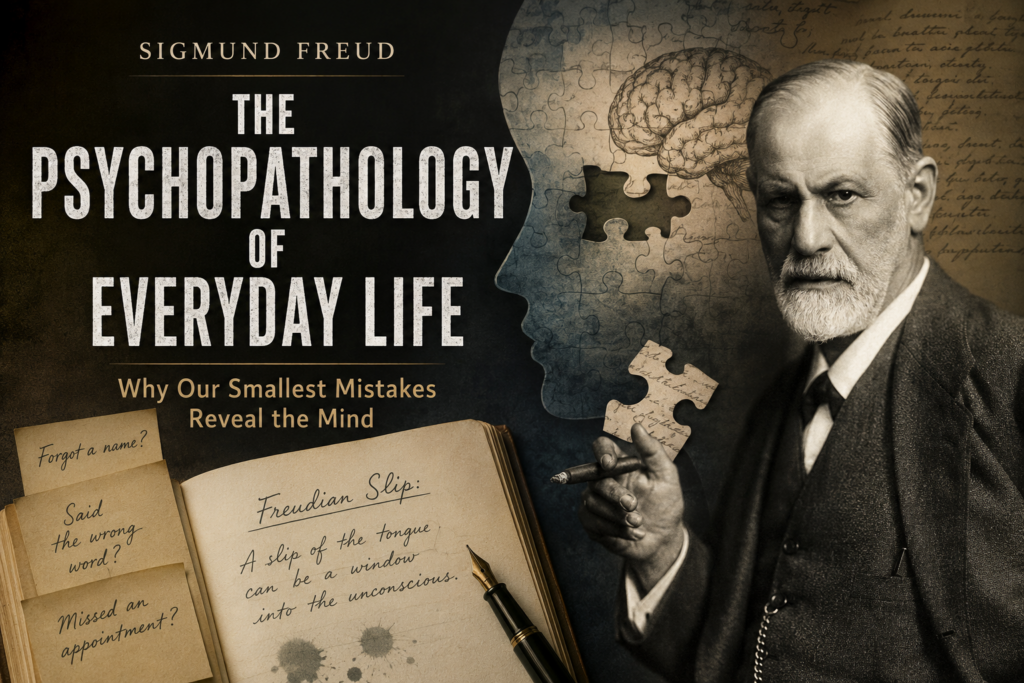
Every time someone says “that’s not just a Freudian slip” and the room laughs a little too knowingly, everyone is quoting — without realizing it — a book that’s now 125 years old. Sigmund Freud’s The Psychopathology of Everyday Life (1901) is where the whole idea of the Freudian slip actually comes from, and it’s a stranger, funnier, and more personal book than its reputation suggests. Below is a complete, chapter-by-chapter summary — what each chapter actually argues, in plain English, with Freud’s own examples explained rather than just listed.
Quick answer, if you’re in a hurry: Freud argues that everyday mistakes — forgetting a name, a slip of the tongue, a dropped cup, a missed appointment — are never really accidents. Each one is a small, disguised compromise between what you consciously meant to do and something you didn’t want to think about.
The book, at a glance
- Author: Sigmund Freud
- First published: 1901, as a journal article in the Monatsschrift für Psychiatrie und Neurologie; it appeared in standalone book form in 1904, then grew through several more German editions, with new examples added almost every time
- This summary follows: the A. A. Brill English translation (1914), one of the most widely circulated free editions
- Chapters: 12
- Core thesis: nothing in mental life is a genuine accident
The One Idea That Runs Through All Twelve Chapters
What you meant to do or say → gets interrupted by → something you didn’t want to think about → the result is a compromise: the slip itself.
Once you can see that shape, every chapter is really Freud pointing the same flashlight into a different room of the mind — names, words, memories, speech, writing, actions, judgment, and finally, chance itself.
Key Terms Worth Knowing First
- Faulty act (Fehlleistung, sometimes translated “parapraxis”) — Freud’s own umbrella term for every slip in this book, verbal, mental, or physical.
- Repression — pushing an uncomfortable thought out of conscious awareness. It doesn’t disappear; it keeps pressing from underneath.
- The unconscious — the part of the mind holding thoughts and wishes that are active and influential, but not directly available to awareness.
- Overdetermination — when a slip has more than one cause feeding into it at once, not a single tidy explanation.
- Concealing memory (often called a screen memory) — a memory that survives clearly not because it mattered, but because it’s standing in for something else that did.
Quick Map: All 12 Chapters at a Glance
| # | Chapter | The one-line hook |
|---|---|---|
| 1 | Forgetting of Proper Names | Why you blank on a name right when it’s wired to something you’d rather not think about |
| 2 | Forgetting of Foreign Words | The same blanking, on a quotation you know cold |
| 3 | Forgetting of Names and Order of Words | Why memory always snaps at the same weak link |
| 4 | Childhood and Concealing Memories | The memories you kept aren’t the ones that mattered — they’re stand-ins |
| 5 | Mistakes in Speech | The chapter that gave us “the Freudian slip” |
| 6 | Mistakes in Reading and Writing | The eye and the hand make the same mistake as the tongue |
| 7 | Forgetting of Impressions and Resolutions | “I forgot” as a polite disguise for “I didn’t want to” |
| 8 | Erroneously Carried-out Actions | Clumsiness is rarely just clumsiness |
| 9 | Symptomatic and Chance Actions | What your fidgeting is quietly saying |
| 10 | Errors | When the unconscious gets a wrong belief past you entirely |
| 11 | Combined Faulty Acts | When one leak isn’t enough and the same thing surfaces twice in a day |
| 12 | Determinism, Chance, and Superstitious Beliefs | The payoff: there’s no such thing as a real accident |
Chapter 1: Forgetting of Proper Names
You don’t forget a name at random. Something in you doesn’t want to follow the thread that name is attached to, and it reaches for a nearby name instead.
Freud opens with his own case, and the whole book is built on it. On a coach trip through Bosnia, right after a conversation touching on death and sexuality, he found he couldn’t recall the name of the painter of the Orvieto Cathedral frescoes — Luca Signorelli. Two wrong names kept surfacing in its place: Botticelli and Boltraffio. Tracing the thread backward, he found the region’s name, a town where he’d once heard upsetting news about a patient’s death, and the suppressed topic of the conversation were all quietly wired together — by sound, by subject — to the very things he’d just been trying not to think about. The name didn’t vanish. It got swapped for safer relatives.
His generalization: forgetting a name takes two ingredients — a personal reason to avoid what it’s connected to, and a substitute name close enough in sound or sense to take its place.
Chapter 2: Forgetting of Foreign Words
The same mechanism, but now on a word you’d have sworn you knew cold.
The centerpiece example: a young academic can’t finish a Virgil line he’s quoted many times — “Exoriare aliquis nostris ex ossibus ultor” (“let some avenger rise from my bones”) — stumbling specifically on the word “aliquis.” Free-associating outward from the broken word, through relics, a saint’s blood-miracle, and calendar dates, Freud arrives at a real, current worry the man hadn’t voiced aloud: whether a woman he’s involved with has missed her period. He wasn’t repressing the word itself. He was avoiding the entire emotional neighborhood the word happened to sit in.
The upshot: this isn’t only about names tied to people. Any word wired into the same associative chain as something you’re avoiding is fair game.
Chapter 3: Forgetting of Names and Order of Words
The same forgetting shows up in longer chains — memorized verses, ordered lists, quotations — and the exact spot where memory snaps is rarely a coincidence either.
Freud works through cases where people consistently mangle the same line of a memorized text, transpose words, or lose their place at one particular, recurring spot. He also extends the mechanism to remembering things in the wrong order, or misattributing where a memory came from. The “weak link” is weak precisely because it brushes against something uncomfortable — a small, local resistance, not a general failure of memory.
Chapter 4: Childhood and Concealing Memories
What you actually remember from early childhood isn’t a highlight reel of what mattered. It’s often a set of oddly vivid, trivial-seeming scenes standing in for something else.
Freud asks why most of early childhood disappears (what he calls infantile amnesia), while a handful of apparently unimportant scenes — an afternoon, an object, a smell — stay perfectly sharp. His answer: these survivors, “concealing memories” (elsewhere translated as screen memories), aren’t kept for their own importance. They’re kept because they’ve been quietly enlisted to represent, and disguise, a different memory or wish too charged to store directly. The concealing memory stands in front of the real one, like an understudy who never leaves the stage — which reframes autobiography itself: your earliest “memories” are less a recording than a construction, assembled later to serve a present psychological need.
Chapter 5: Mistakes in Speech
This is the chapter that gave the world “the Freudian slip” — and it’s by far the longest and most example-dense chapter in the book, because speech gives the unconscious the most chances to break cover.
The most famous case: the President of the Austrian House of Deputies, opening a session he privately expects to go badly, declares it closed instead of open. Freud’s reading: the president unconsciously wished he were already elsewhere, and that wish “broke through” onto the one word where it could hide in plain sight. He collects dozens more — a phrase of praise for a rival that twists into something backhanded, a description of an “equal” arrangement between two people that slips and hands the freedom to only one of them. He sorts these by mechanism (two words colliding by sound, one phrase bleeding into another, a loaded idea displacing a neutral one), but the throughline never changes: two intentions were active, one permitted and one suppressed, and the slip is where they collided and merged.
He also argues directly with an earlier, purely mechanical account of slips from linguists Meringer and Mayer, who explained them by sound-similarity alone. Sound-similarity often supplies the opportunity, Freud says, but a psychological motive usually supplies the reason it happened on that word, at that moment.
Chapter 6: Mistakes in Reading and Writing
The eye and the hand make the same kind of mistake as the tongue.
The same logic repeats in reading and writing: someone preoccupied with a worry keeps “seeing” it in unrelated text, misreading ordinary signs and headlines as words connected to whatever’s weighing on them. In writing, Freud collects wrong dates, repeated or dropped words, and small written errors that trace back to something the writer was avoiding or quietly wishing for. Given half a chance, the hand and the eye default to whatever’s already emotionally loaded.
Chapter 7: Forgetting of Impressions and Resolutions
“I forgot” is very often “I didn’t want to,” wearing a disguise.
Two related things sit in this chapter: forgetting things that happened, and forgetting to carry out something you’d resolved to do — mailing a letter, keeping an appointment, returning a favor. This is one of the longer chapters because Freud piles on example after example, and the point of the pile-up is cumulative: the sheer variety of “innocent” forgetting he can trace back to ambivalence is itself the argument. Someone keeps “forgetting” to settle up with a friend they secretly resent; someone “forgets” to visit a person they’ve quietly gone cold on. The forgetting doesn’t fight your conscious intention head-on. It just declines to cooperate with it.
Chapter 8: Erroneously Carried-out Actions
Clumsiness is rarely just clumsiness.
Freud gathers cases of breaking, dropping, or damaging objects tied to a person or situation someone has mixed or hidden feelings about, plus small mishaps and self-injuries that turn out to be strangely well-timed — landing right when they’re psychologically useful, whether as an excuse to avoid something dreaded or a disguised form of self-punishment. What looks purely mechanical, in his reading, is usually a suppressed impulse finding a physical exit that the conscious mind can immediately disown: I didn’t mean to.
Chapter 9: Symptomatic and Chance Actions
The small, absent-minded things you do with your hands while your mind is “elsewhere” aren’t meaningless. Your mind isn’t elsewhere — it’s right there, just not talking.
Fidgeting with an object during a difficult conversation, humming a tune whose lyrics happen to name exactly what’s on your mind, an idle habit that shows up only around one particular person or topic — Freud treats these tics as a running unconscious commentary alongside conscious behavior. Quieter than a slip of the tongue, but readable the same way, once you know to look.
Chapter 10: Errors
Sometimes the unconscious doesn’t scramble your words or your memory — it gets an outright wrong belief past your judgment, and you’ll defend it as simple fact.
This chapter covers confidently-held mistakes: wrong dates, wrong attributions, wrong recollections of who-said-what, held onto until someone corrects them. Freud turns this on himself more than once, walking through his own factual slips — including misattributing an idea to the wrong colleague — and tracing them back to threads of professional rivalry or ambition he hadn’t consciously registered at the time.
Chapter 11: Combined Faulty Acts
Sometimes the same suppressed material doesn’t settle for one slip. It leaks through two or three channels in a single day, as if determined to be noticed.
Someone forgets an appointment with a person, then separately makes a verbal slip about that same person later the same day. Freud reads these clusters as a sign of pressure building underneath — one leak isn’t always enough to relieve what’s underneath, so it finds a second and sometimes a third route out.
Chapter 12: Determinism, Chance, and Superstitious Beliefs
Here Freud makes the philosophical claim underneath everything above fully explicit: in mental life, there’s no such thing as real chance — only apparent chance, standing in for a hidden but perfectly real cause.
He contrasts two responses to the same intuition — that small errors “mean something.” The superstitious person is, in his view, half right: they correctly sense a hidden determination behind trivial events, but misplace it outward, onto fate or omens. Freud’s move is to relocate that same determination back where he thinks it actually lives — inside the person’s own unconscious. He closes by tying the whole book explicitly to dream interpretation and to neurotic symptoms: faulty acts, dreams, and symptoms are, in his account, three dialects of one underlying language.
Frequently Asked Questions
Did Freud actually coin the phrase “Freudian slip”? No — and this trips up almost every summary of this book. Freud wrote in German and called these mistakes Fehlleistungen, literally “faulty functions” or “faulty acts” (exactly how the Brill 1914 translation renders it throughout). The more clinical English term, parapraxis, comes from a different, later translation. “Freudian slip” itself is a colloquial phrase that entered English usage afterward — dictionaries date its earliest recorded use to the late 1920s — and it’s the version that stuck in everyday conversation, even though Freud never used it himself.
Is there any actual scientific evidence for Freudian slips? Some, though less than Freud claimed. A frequently cited 1979 study by researchers Michael Motley and Bernard Baars had male participants primed with either a sexual or an electric-shock-related cue, then read word lists designed to produce spoonerisms tied to both themes. Primed participants made significantly more of the “matching” slip. That’s real evidence that unconscious priming shapes the content of a slip. What’s much less supported today is Freud’s stronger claim — that every single slip, without exception, has a hidden meaning if you dig far enough.
How many chapters does The Psychopathology of Everyday Life have? Twelve, in the standard editions, including the A. A. Brill 1914 translation — running from “Forgetting of Proper Names” through to the closing chapter on determinism, chance, and superstitious beliefs.
Is the book worth reading today, or is it just historically important? Both. As science, its central method — reading a “true” hidden meaning off a chain of free associations — has been challenged, most famously by the philosopher of science Karl Popper, who argued it’s built so that almost any interpretation can be made to fit, which makes it very hard to disprove. As a piece of writing, it’s still remarkably readable and often funny, and Freud uses himself as the guinea pig throughout — a big part of why it remains one of his most widely read books, more than a century on.
What’s the difference between a “Freudian slip” and just a normal mistake? By Freud’s own definition, not every slip counts — only ones where a real, if buried, motive sits behind the substitution. In casual modern use, the term has been stretched to cover almost any embarrassing verbal slip, including ones that are really just fatigue or habit, with no repression involved at all.
The Takeaway
Freud wrote this book about slips and lapses, but its real subject is the gap between who we think we are and what we’re actually always doing. That gap doesn’t close just because psychoanalysis has fallen out of academic fashion — if anything, it gets more interesting once you stop taking “hidden unconscious wish” on faith and start asking, like Freud did, why that mistake, on that day, to that person.
Next time you catch yourself mid-slip, you might not have Freud’s confidence that you’ve found the hidden message. But you’ll probably still wonder what it was.
– desineo